Baby's first post
I've put this off for years, and for no good reason. (Well, impostor syndrome, mostly.) But here we are, and I'm excited to get going.
I often wonder if I went into climate science for the graphics.
Satellite imagery and weather/climate information can be very beautiful to visualize, and a good graphic or map is one that conveys a lot of information quickly and simply, but can be studied for much longer. It's dreamy stuff.
Take something as "simple" as a map projection. It doesn't show data per se, but there's a lot of information about area and continents and oceans in there.
One of my favorites is the Goode homolosine, created in the 1960s by a geographer who wanted an alternative to the Mercator projection. And for decent reason: the homolosine shows areas near the polls with a lot less distortion than Mercator does.
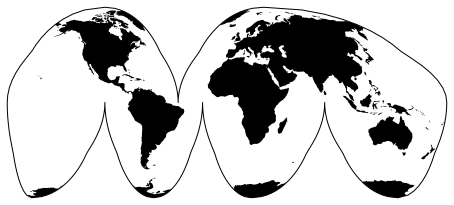
Maybe my favorite part of this projection, though, is how it looks like what you'd get if you peeled Earth like an orange. And while the homolosine would be a terrible way to show a lot of things, I love thinking about it and bending the flaps around in my mind to make the globe whole again.
△△△
As a grad student and postdoc, and even today when I do more technical mapping work for my job, I've always spent what feels like a LOT more time fine-tuning the maps and graphics of a paper or project than I would spend on the data analysis and research itself.
What color scheme should I use? How thick should the continental outlines be? What projection works best? These questions can haunt me; I've lost hours to researching little-known matplotlib parameters and deciding on minutiae like the z-order of points in a scatter plot.
I have to remind myself that making graphics to visualize data is a crucial part of the research process, and it takes a lot of data wrangling to get to that stage. You should spend time on this part. Still, I've questioned whether my PhD was a degree in how matplotlib works, rather than one in climate science. At best, it was both. At worst, well...
Scientists aren't always design-minded
It's safe to say that scientists don't always have the best eye for graphic design or science communication, and the more self-serious ones out there even seem to take pride in their inability to make an accessible graphic. There are classic books on how to design scientific figures, but they're old and outdated for the mobile device age. Unless you're going to school for it, there's really was no way to learn these things beyond teaching them to yourself.
For me, it felt as if some of the things that brought me to climate science in the first place — communicating climate change; making accessible and narrative-driven visuals; spending time with open-source software and data — were not the things that got grants funded or papers accepted.
The thinking has evolved in the past decade, of course, and graphic design-driven map making has always been further along in some disciplines, like geography and urban planning. I think the Earth sciences are learning a ton from them.
For climate science in particular, I think data viz smarts really co-evolved with the maturation of the graphics in the IPCC reports. AR5, for example, was a pretty monumental shift in how climate change predictions had been presented, and the effort even produced a style guide, a first of its kind. These reports served as academic texts to a lot of us. They were tomes of our current scientific understanding of climate change.
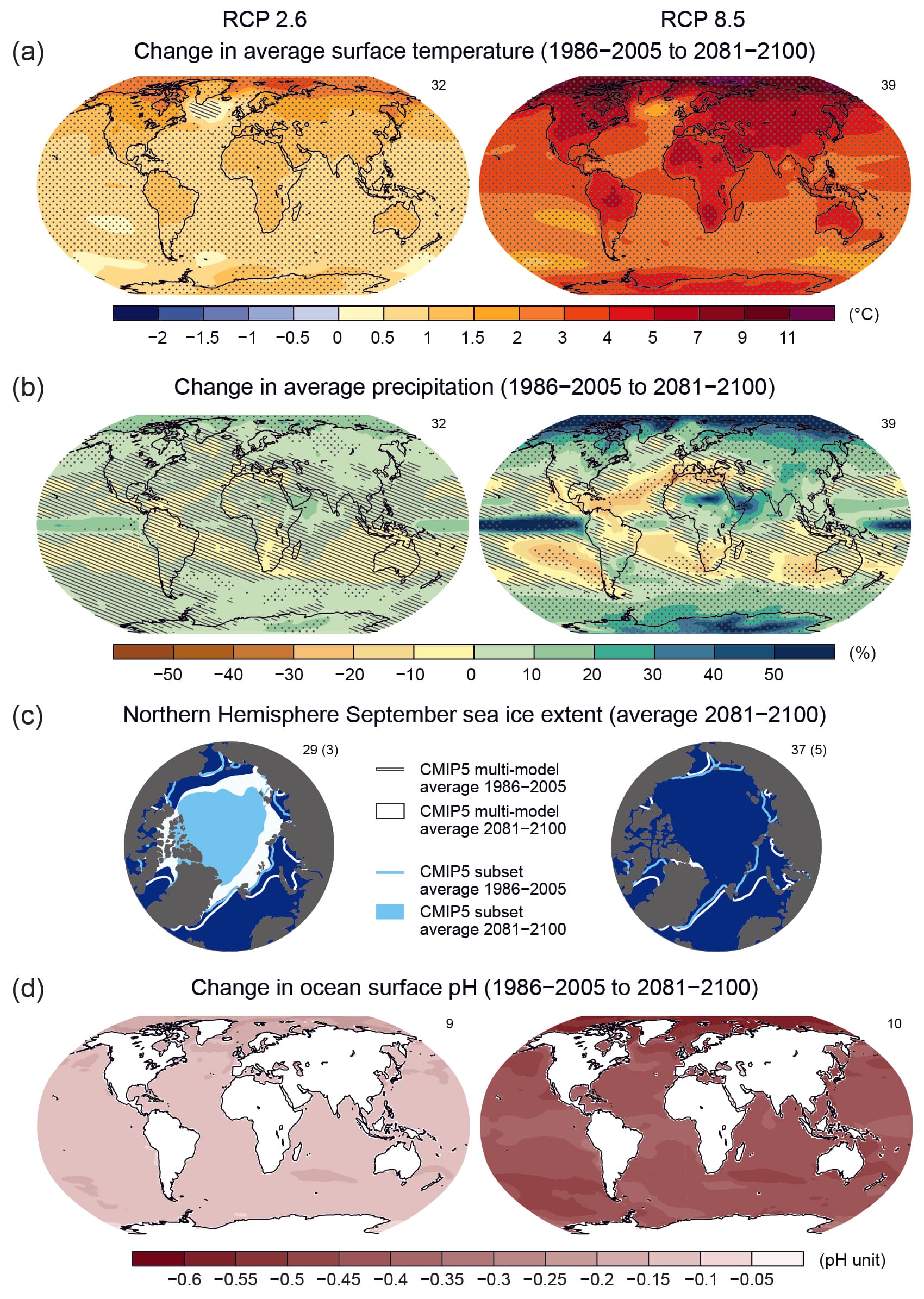
Figure 8 from the IPCC AR5 Summary for Policymakers, showing low- and high-emissions climate trajectories for temperature, precipitation, sea ice extent, and ocean surface pH. This was one of the first times the Robinson projection and smarter graphics were used in a report like this.
Little by little, map projections and color schemes like these have trickled into academic publications and conference presentations. It's been a great thing to witness, and I remember holding high standards for figures when I worked as an academic editor myself, regularly asking authors to modify things to make them more accessible, and to read up on why this is important.
These IPCC-style graphics still have a long way to go to be accessible to the general public, I think, and to be readable on cell phones... but that's not ultimately why they're being created.
But I'd like to get better at it
Anyway, I've been bouncing among climate research, academic editing, and energy nonprofit work for the past 15 years, and my more recent work has taken me away from weather and climate research. I've realized I really miss it, and I'm starting up this blog so I can hold myself more accountable and get back in the game — and document what I try out.
In particular, I'd like to start trying my hand at more data journalism and environmental change analysis with the growing number of tools out there, and I've realized my lack of front- and backend skills have been holding me back from my goals.
I've also felt some impostor syndrome about all of this; careers for PhD scientists in the journalism and data viz space seem pretty rare. When I finished school back in 2015, I didn't know this kind of paid work existed, and I still think it only lives at the sidelines of newsrooms and tech companies.
Also, the work that people do out there is already so impressive. It's hard to know where to start or how to contribute, and not to feel frustrated with my lack of skills in the process.
But I'm trying to change my comfort level with it all. I'll be building out this website with posts and projects as I move through them, and I'm hoping to keep things ambitious. If you've stumbled across this — and I sure as hell wouldn't tell anyone to come here — I hope that you get some enjoyment out of it. And if not, well then, my bad.